Artificial Intelligence (AI) in Materials Discovery Market is Expected to Experience Steady Growth with a 29.4% CAGR
The Business Research Company’s Artificial Intelligence (AI) In Materials Discovery Global Market Report 2026 – Market
Press Release Disclaimer: This is a press release distributed through the XPR Media network. It has not been independently verified by our newsroom.
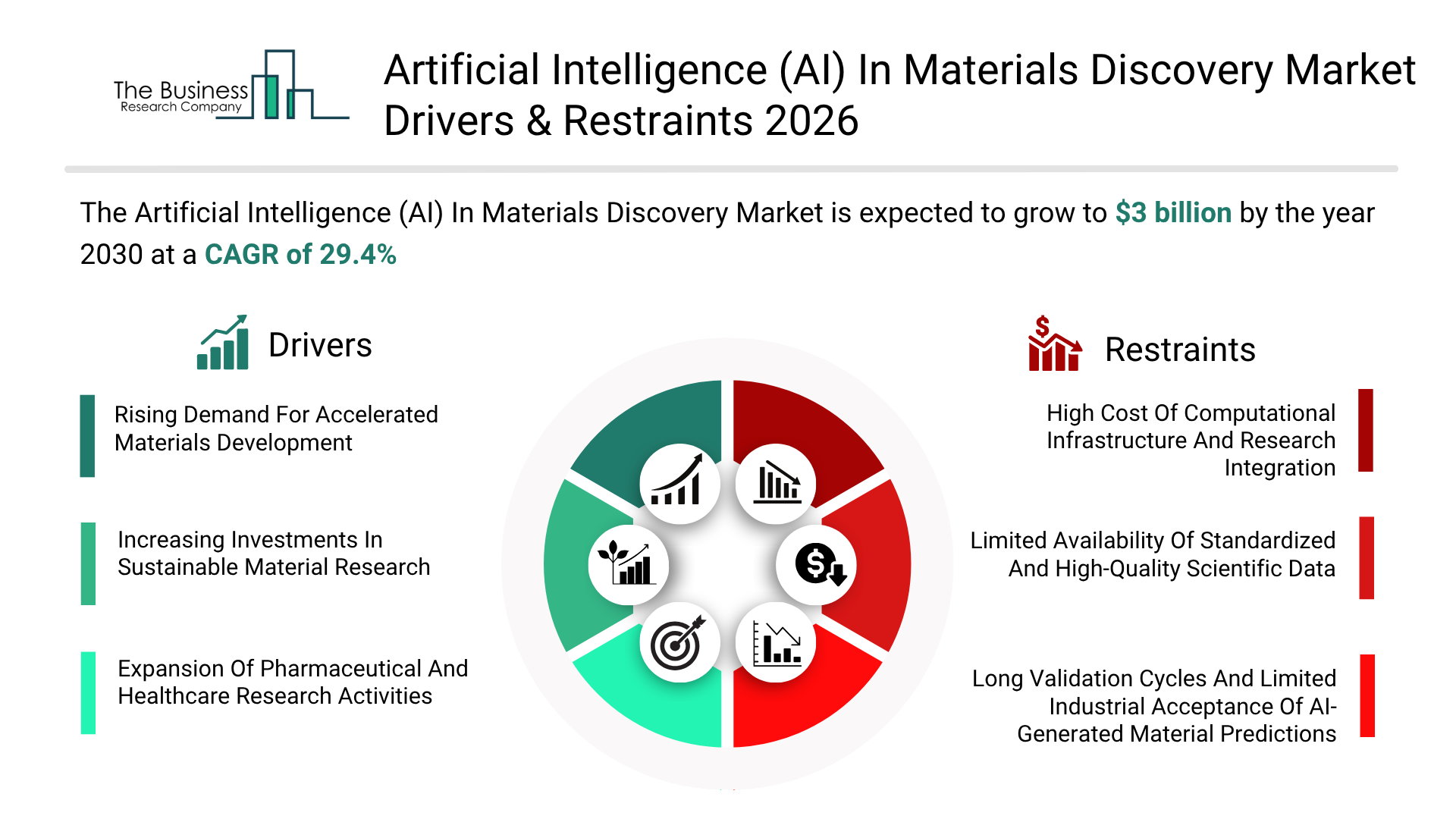

The Business Research Company’s Artificial Intelligence (AI) In Materials Discovery Global Market Report 2026 – Market Size, Trends, And Forecast 2026-2035
LONDON, GREATER LONDON, UNITED KINGDOM, October 16, 2026 /EINPresswire.com/ — “The Artificial Intelligence (AI) in Materials Discovery market is rapidly gaining traction as it reshapes how new materials are developed and brought to market. With AI technologies becoming more integrated into scientific research, this sector is positioned for substantial growth, driven by advancements in computational capabilities and increasing demand from various industries. Below is an in-depth look at the market size, regional leadership, key segments, growth drivers, major players, and emerging trends shaping this dynamic market.
Market Size and Its Relation to the Larger Materials and Chemicals Industries
The Artificial Intelligence (AI) in Materials Discovery market is projected to exceed $3 billion by 2030. This figure is a part of the broader Advanced Materials market, which is estimated to reach around $133 billion in the same year, with AI in materials discovery representing roughly 2% of that parent market. When viewed within the even larger Chemicals industry, expected to hit $7,007 billion by 2030, the AI in materials discovery segment accounts for nearly 0.04% of the total market value, highlighting its growing but still niche role within the sector.
Request A Free Sample Of The Artificial Intelligence (AI) In Materials Discovery Market Report
https://thebusinessresearchcompany.com/sample_request?id=56971924&type=smp&name=Artificial%20Intelligence%20%28AI%29%20In%20Materials%20Discovery%20Market%20Report%202026&utm_source=EINPresswire&utm_medium=Paid&utm_campaign=Oct_PR
North America’s Dominance in AI-Driven Materials Discovery by 2030
North America is set to be the leading region in the Artificial Intelligence (AI) in Materials Discovery market by 2030, with a market value anticipated at $0.9 billion. This represents rapid growth from $0.3 billion in 2025, at a compound annual growth rate (CAGR) of 29%. The region’s leadership is supported by its concentration of top AI technology providers, advanced research infrastructures, and strong public-private sector investments in computational materials science. Collaborative efforts between universities, national labs, and industry players, coupled with rising demand for cutting-edge materials in clean energy, aerospace, and semiconductors, underpin this robust expansion.
The United States as the Largest Country-Level Contributor to Market Growth
The USA is expected to hold the largest share in the global Artificial Intelligence (AI) in Materials Discovery market by 2030, valued at $0.8 billion. From $0.2 billion in 2025, the market is forecasted to grow at a CAGR of 29%. This growth is fueled by significant funding for AI-driven scientific research, extensive deployment of high-performance computing resources, and the increasing commercial availability of AI-based materials discovery platforms developed by startups and established firms. The demand for swift innovation in sustainable, high-performance materials across various industries, combined with ongoing innovation through strategic partnerships, continues to drive market momentum.
Access The Detailed Artificial Intelligence (AI) In Materials Discovery Market Report Here
https://thebusinessresearchcompany.com/report/artificial-intelligence-ai-in-materials-discovery-market-report?utm_source=EINPresswire&utm_medium=Paid&utm_campaign=Oct_PR
Software Segment to Lead in the Artificial Intelligence in Materials Discovery Market by 2030
Within the Artificial Intelligence (AI) in Materials Discovery market, the software segment is projected to be the largest, accounting for 60% or $2 billion of the total market by 2030. This dominance is attributed to widespread adoption of AI-powered modeling and simulation tools, growing reliance on cloud-based materials informatics, and increasing integration of predictive analytics in research processes. Additional drivers include automated data management and visualization technologies that accelerate material screening and optimization, enabling faster commercialization of new materials.
Key Market Segments by Material Type, Technology, Deployment, and End-User
The market is categorized by material types such as polymers, metals and alloys, ceramics, composites, nanomaterials, and semiconductors. Technological segmentation includes machine learning, deep learning, generative artificial intelligence, and natural language processing. Deployment modes cover on-premise, cloud-based, and hybrid systems. End-users range across chemical companies, pharmaceutical firms, research institutions, manufacturing entities, and other sectors utilizing AI-enabled materials discovery.
Consistent 29% CAGR Expected Through to 2030
The Artificial Intelligence (AI) in Materials Discovery market is forecasted to grow at a steady compound annual growth rate (CAGR) of 29% leading up to 2030, reflecting strong and sustained interest from diverse industry stakeholders and consistent technological advancements.
Factors Propelling Market Expansion in AI-Driven Materials Discovery
One of the central growth drivers is the increasing demand for accelerated materials development. Organizations are turning to AI-powered platforms to reduce material design cycles, improve predictive accuracy, and quickly pinpoint high-performance compounds suitable for commercial applications. Traditional experimental approaches are time-consuming and resource-intensive, whereas AI-based virtual screening and simulations drastically speed up validation processes and research productivity across multiple industries. This transition is expected to contribute about 2.5% annual growth to the market.
Another important factor is the rise in investments focused on sustainable material research. Both public and private sectors are dedicating more funds to environmentally friendly materials aimed at reducing carbon emissions and promoting circular manufacturing. AI technologies help researchers analyze complex chemical data efficiently, identifying promising sustainable materials such as recyclable components, advanced batteries, and resource-saving manufacturing inputs. These sustainability efforts are expected to add approximately 2.0% annual growth to the sector.
Additionally, the growth of pharmaceutical and healthcare research is playing a crucial role. AI is increasingly used to identify novel biomaterials, optimize molecular structures, and support precision drug development. Computational tools enhance material selection for medical devices, drug delivery, tissue engineering, and diagnostics. Expanding biomedical research and investment in life sciences innovation are strengthening demand for AI-assisted discovery tools, contributing around 1.1% annual growth.
Significant Growth Prospects in Software, Hardware, and Services Markets
The most promising opportunities lie within the software, hardware, and services segments of the AI in materials discovery market. These sectors collectively are projected to generate over $1.8 billion by 2030, driven by increased adoption of AI-powered platforms, expanded high-performance computing infrastructure, and rising demand for cloud-based research solutions. The ongoing digital transformation of industrial research labs and continual improvements in predictive modeling further support this growth. This momentum underscores efforts to accelerate innovation, enhance research efficiency, and shorten material development timelines.
From 2025 to 2030, the software segment is expected to grow by $1 billion, services by $0.5 billion, and hardware by $0.3 billion. The market is shaped by AI software developers, computational materials science firms, cloud service providers, and scientific research platform vendors. Key focus areas include machine learning-driven molecular modeling, high-throughput screening, generative design, predictive property analysis, and AI-enhanced simulation platforms, all aimed at speeding up next-generation material innovation while emphasizing sustainable development.
Market Leadership and Competitive Landscape Overview
As of 2025, Schrödinger Inc. leads the market with a 1% share, owing to its AI-driven computational chemistry and molecular simulation platform. The company’s advanced physics-based modeling and predictive capabilities facilitate rapid material innovation and optimized research workflows in a variety of industrial and scientific applications.
Other major players in the Artificial Intelligence (AI) in Materials Discovery market include Dassault Systèmes, Citrine Informatics Inc., CuspAI, QuesTek Innovations, Iktos SA, Atinary Technologies GmbH, Kebotix Inc., Aionics Inc., Materials Zone Ltd., Intellegens, Toyota Research Institute, IBM, Exabyte.io, Enthought Inc., Google LLC, Polymerize AG, Polaron Analytics, Phaseshift Technologies, and Microsoft Corporation.
Market Fragmentation and the Role of Leading Companies
The AI in materials discovery market is fairly fragmented, with the top 10 companies holding about 5% of total revenue in 2025. This reflects the evolving nature of technology and the specialized expertise needed in AI algorithms, computational materials science, proprietary data management, and integration with high-performance computing environments. Leaders such as Schrödinger Inc., Dassault Systèmes, and Citrine Informatics own notable shares through their AI-powered discovery platforms, strategic collaborations, and domain-specific software offerings. As demand grows for faster material innovation, digital workflows, and sustainable solutions, these companies are expected to strengthen their competitive edge through platform improvements and partnership networks.
Key Raw Material Suppliers Powering the AI in Materials Discovery Market
Important raw material suppliers include semiconductor and cloud infrastructure giants such as Advanced Micro Devices, Intel Corporation, Taiwan Semiconductor Manufacturing Company, Samsung Electronics, SK hynix, Micron Technology, Broadcom Inc., Marvell Technology, Qualcomm Incorporated, Synopsys Inc., Cadence Design Systems, Ansys Inc., Amazon Web Services, Microsoft Azure, Google Cloud, Oracle Cloud Infrastructure, Dell Technologies, Hewlett Packard Enterprise, and Lenovo Group.
Major Wholesalers and Distributors Serving the Market
Leading wholesalers and distributors facilitating the AI in materials discovery ecosystem include TD SYNNEX, Ingram Micro, Arrow Electronics, Avnet Inc., Redington Limited, Westcon-Comstor, Exclusive Networks, Crayon Group, Insight Enterprises, CDW Corporation, SHI International, Computacenter plc, Softchoice Corporation, Bechtle AG, Carahsoft Technology, ePlus Inc., Presidio Inc., Bytes Technology Group, and SoftwareONE.
Dominant End-Users Benefiting from AI in Materials Discovery
Key end-users encompass major corporations across various sectors such as BASF SE, Dow Inc., Evonik Industries, Covestro AG, 3M Company, LG Chem, Sumitomo Chemical, Mitsubishi Chemical Group, Bayer AG, Johnson Matthey, Toyota Motor Corporation, Airbus SE, Pfizer Inc., Roche Holding AG, Merck KGaA, Novo Nordisk, Siemens Energy, Umicore, Albemarle Corporation, and Saint-Gobain.
Competitive Trends Transforming the Market
The market is being revolutionized by AI-powered collaborative approaches that accelerate material development, shorten research cycles, and enable data-driven innovation. For example, in June 2025, Hyundai Motor Group partnered with CuspAI to speed up AI-driven materials discovery for next-generation mobility solutions. CuspAI’s proprietary generative AI platform combines a materials search engine, data-driven simulations, and machine learning models to reduce development costs and facilitate the creation of sustainable, high-performance materials for future automotive applications.
Strategies Companies Employ to Maintain Market Leadership
Leading players are leveraging several cutting-edge strategies to stay competitive, such as using generative AI to rapidly design novel materials, deploying autonomous laboratory platforms to enhance experimental efficiency, developing foundation models for improved molecular property predictions, enabling cloud-based materials informatics for collaborative research, and integrating quantum computing to advance complex materials simulations.
Summary
The Artificial Intelligence (AI) in Materials Discovery market is set for rapid expansion, driven by technological innovation, increasing investments in sustainable materials, and growing demand from pharmaceutical and industrial sectors. North America, especially the USA, will lead this growth, supported by strong research ecosystems and commercial activity. Software solutions will dominate the market, complemented by hardware and services. The competitive landscape is diverse, with companies focusing on AI-driven modeling, high-throughput screening, and collaborative platforms to accelerate next-generation material innovation. As the market matures, strategic partnerships, advanced computing integrations, and sustainability-focused research will shape its trajectory, offering significant opportunities for stakeholders across the materials science and chemicals industries.
The 2026 edition of our market reports now delivers enhanced analytical coverage through market attractiveness scoring and analysis, total addressable market (TAM) analysis, company scoring matrix graphics and tables, Excel-based forecasting dashboards, market hotspots infographics, key technologies and future trend analysis, plus updated graphics and tables.
Learn More About The Business Research Company
The Business Research Company (www.thebusinessresearchcompany.com) is a leading market intelligence firm renowned for its expertise in company, market, and consumer research. We have published over 30,000+ reports across 27 industries and 60+ geographies. Our research is powered by 1,500,000 datasets, extensive secondary research, and exclusive insights from interviews with industry leaders.
We provide continuous and custom research services, offering a range of specialized packages tailored to your needs, including Market Entry Research Package, Competitor Tracking Package, Supplier & Distributor Package and much more.
Disclaimer: Please note that the findings, conclusions and recommendations that TBRC Business Research Pvt Ltd delivers are based on information gathered in good faith from both primary and secondary sources, whose accuracy we are not always in a position to guarantee. As such TBRC Business Research Pvt Ltd can accept no liability whatever for actions taken based on any information that may subsequently prove to be incorrect. Analysis and findings included in TBRC reports and presentations are our estimates, opinions and are not intended as statements of fact or investment guidance.
Contact Us:
The Business Research Company
Americas +1 310-496-7795
Europe +44 7882 955267
Asia & Others +44 7882 955267 & +91 8897263534
Email: marketing@tbrc.info
Follow Us On:
LinkedIn: https://in.linkedin.com/company/the-business-research-company“
Oliver Guirdham
The Business Research Company
+44 7882 955267
info@tbrc.info
Visit us on social media:
LinkedIn
Facebook
X
Legal Disclaimer:
EIN Presswire provides this news content “as is” without warranty of any kind. We do not accept any responsibility or liability
for the accuracy, content, images, videos, licenses, completeness, legality, or reliability of the information contained in this
article. If you have any complaints or copyright issues related to this article, kindly contact the author above.

Media gallery